Rapid shifts in skills, job roles, employee expectations, and technologies like generative AI have made it challenging for HR leaders to keep up. But while the pace of change is unrelenting, some organizations are navigating volatility, uncertainty, complexity, and ambiguity with clarity and control.
“In this environment, those who are succeeding not only recognize the ever-changing nature of business, but have the agility to respond to it,” Jamie explains. “They’re able to pivot as change comes upon them because they’re set up to realign themselves as priorities shift.”
That kind of agility isn’t just about implementing new systems or policies. It starts by helping people — employees, managers, HR, and executives — shift their thinking in a way that enables sustainable transformation. In her upcoming People Fundamentals webinar, The 2026 Performance Enablement Shift: HR’s Role in the AI Era, Jamie will explore the biggest obstacles facing these groups, why the challenges exist, and the steps HR leaders can take to overcome them to build high-performing, adaptable teams that deliver better business outcomes.
Shifting from performance management to performance enablement
In a world of constant disruption, traditional performance management no longer fits. Annual reviews and infrequent goal-setting are too slow, too reactive, and too easy to forget.
“They’re like New Year’s resolutions,” Jamie says. “They last about a month, and then everybody forgets about them.”
Performance enablement is a modern and adaptive approach designed with the employee experience at the center. It empowers employees to set and track goals that align with the organization’s vision, creating clarity, accountability, and meaning in their work. It also equips organizations to stay agile and competitive.
It also aligns with employee expectations, which are shifting. “There is an ever-increasing appetite from employees to feel heard, to be coached, and to see how their growth is going to be supported in an organization,” Jamie notes.
This requires redefining the manager’s role from directing work to coaching people. When employees receive regular feedback and development-focused conversations, feedback, and recognition, they grow as individuals, strengthen team collaboration, and deepen their relationship with the business.
Positive cultural change flows naturally from it, enhancing both employees and the organization. “If employees feel like they are part of something, they’re more likely to be engaged and therefore retained,” Jamie explains. “And, if I’m getting feedback that allows me to contribute to my company’s overall strategy, I can adjust and grow from that and be a better contributor to the overall organization’s objectives.”
Changing stakeholder mindsets
At the core of performance enablement transformation is understanding and planning for the behavioral shifts — not just process and technology changes — that need to happen within the organization.
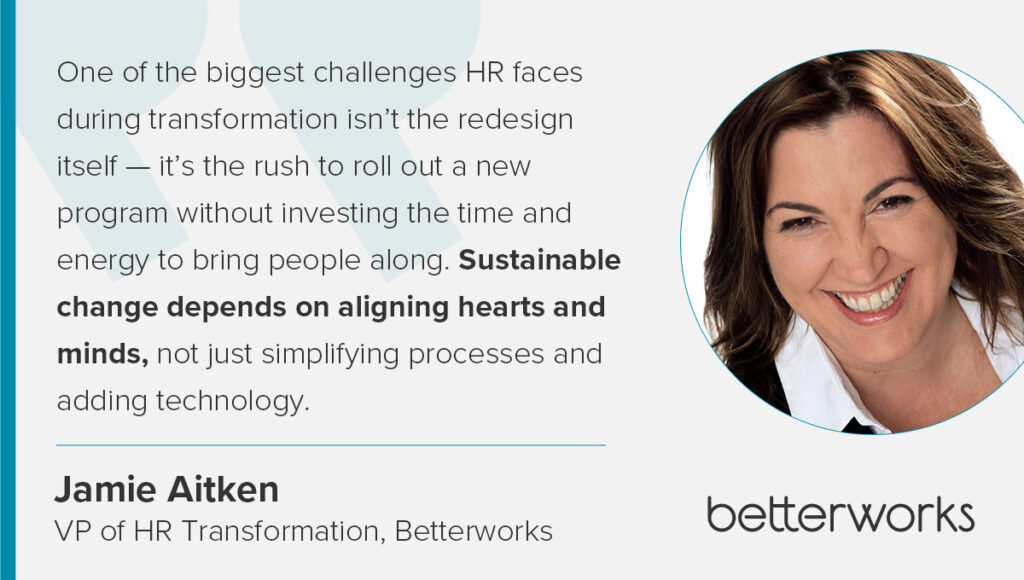
“One of the biggest challenges HR faces during transformation isn’t the redesign itself — it’s the rush to roll out a new program without investing the time and energy to bring people along,” Jamie explains. “Sustainable change depends on aligning hearts and minds, not just simplifying processes and adding technology.”
Successful transformation requires that employees shift from passive recipients to active participants, managers turn from being evaluators to being coaches, leaders change from delegators to cultural stewards, and HR moves from process ownership to being the designer of experiences and outcomes. Understanding why these shifts are challenging and how to support each group in making the transition is at the core of the upcoming webinar.
AI can help support these behavioral changes. When integrated into platforms like Betterworks, it simplifies complex workflows, enhances judgment, and drives adoption — helping to reinforce the very behaviors that transformation depends on.
Successful transformation starts with change management
Once HR understands what each stakeholder group is up against, it’s time to focus on change management, the engine behind sustainable transformation. And yet, this is often where HR stumbles.
“It’s really important because it’s the glue that enables transformation,” Jamie says. “When you impact an entire organization with fundamental changes to the way that they approach goals, conversations, feedback, and building alignment and trust that may not exist currently, you can’t do that without focusing on the behavioral shifts that need to happen. We have to invest time and energy into getting people on board in order to sustain transformation.”
Using design thinking, a collaborative approach to problem-solving centered around the human experience, HR can create experiences that engage, inspire, and stick.
Better metrics, better business outcomes
When HR addresses the root challenges that stakeholder groups face, it has an opportunity to redefine success.
“In traditional performance management, we’re stuck measuring process adoption and process completion,” Jamie says. “But once the stakeholder groups are on board and see the new way of being, HR is able to extend into business metrics, like productivity, retention, goal accomplishment, and efficiency improvements.”
This is the ultimate goal of performance enablement: not just a better experience for employees, but a clear business impact.
Build the workforce of the future
Organizations that succeed in the age of AI won’t be the ones who move the fastest, but the ones who move with purpose. Transformation isn’t just about new tools, but about changing the way people work, think, and grow together. HR has the opportunity to lead that charge by enabling performance, supporting mindset shifts, and connecting people strategy to real results. To hear more from Jamie and see how Betterworks can help you drive successful business transformation, register for her January 14, 2026 webinar (US) or the January 21 webinar (EMEA).
Get set for lasting transformation